01The Capability Wall
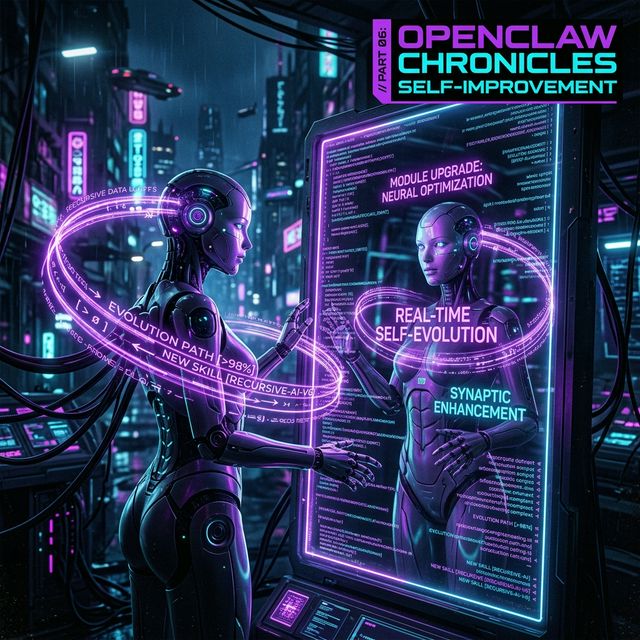
Every agent eventually hits a "wall"—a task that requires a tool it doesn't have. Most systems fail here and ask the human for help. But OpenClaw is built on the philosophy of **Evolution**. If an agent can't solve a problem, it doesn't just give up; it builds the solution.
02The Molt Mechanism
We call this process "Molting." Just as a lobster sheds its shell to grow, an OpenClaw agent sheds its current limitations by generating new skills. When a capability gap is detected, the agent triggers a high-reasoning **Coder Agent** to draft a new `SKILL.md` file.
03Recursive Improvement
The beauty of the local-first architecture is that this new skill is immediately written to the local disk, registered in the agent's brain, and ready for use. The agent can then retry the original task using its newly acquired power.
04Scaling the Evolution
Self-improvement on a single machine is powerful, but what if these mutations could be shared? In our next entry, **Persistence**, we'll explore how we scale this local-first state to the cloud using S3 and DynamoDB, enabling a global ecosystem of evolving agents.